
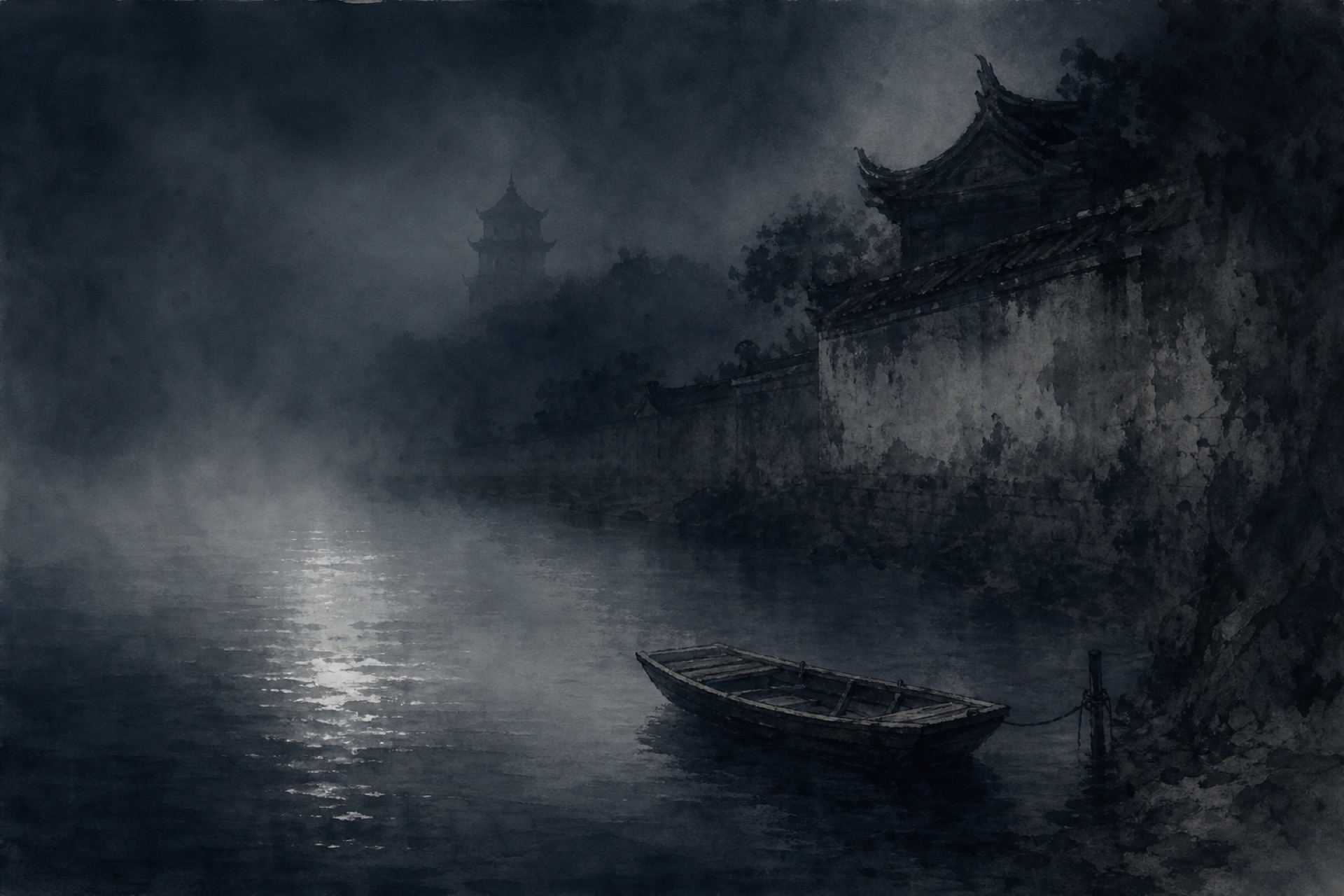
In the year 756, the Tang poet Zhang Ji moored his boat by Maple Bridge, outside the walls of Suzhou, and wrote four lines every Chinese schoolchild knows. They end with a sound: the midnight bell of Cold Mountain Temple, carrying across the water to a sleepless traveler. A bell, marking time, twelve centuries ago. We can't think of a better founding story for a watch brand.
Our name honors the poet-monk of that temple. Han Shan — "Cold Mountain" — is said to have sheltered there, writing his poems on rocks and tree bark. (Ming-dynasty chroniclers admitted they couldn't verify it. We appreciate the honesty.) What is documented: Japan teaches Zhang Ji's poem in its schools, knows him as Kanzan, and counts a Yuan-dynasty painting of Han Shan and his companion Shide among its National Treasures, held by the Tokyo National Museum. In 1958, Gary Snyder's translations carried him to America, and Jack Kerouac dedicated The Dharma Bums to him — "the guardian angel of a generation," as one scholar put it.
The watches are quiet. Each dial is hand-embroidered in silk thread by a small atelier in Suzhou, in the tradition of Suzhou embroidery — a craft on China's national list of intangible cultural heritage since 2006. One dial takes five to fifteen days. Motifs come from public-domain masterpieces, deep space, and gothic art. The watch beneath is deliberately simple — mechanical, no date — and editions are numbered, capped by what the atelier can actually stitch. The price is $900 to $1,200; the few genuinely hand-embroidered dials we know of start at €2,500.
Each watch arrives with its making-of record — hours, stitch techniques, macro photography — and an NFC certificate tying the numbered piece to those records. The silk is sent for ISO light-fastness, perspiration and humidity testing, because "it lasts" is something you prove, not something you write. And the midnight bell? Song-dynasty scholars doubted it, then verified: Suzhou temples really did ring at midnight. We checked too. We always check.